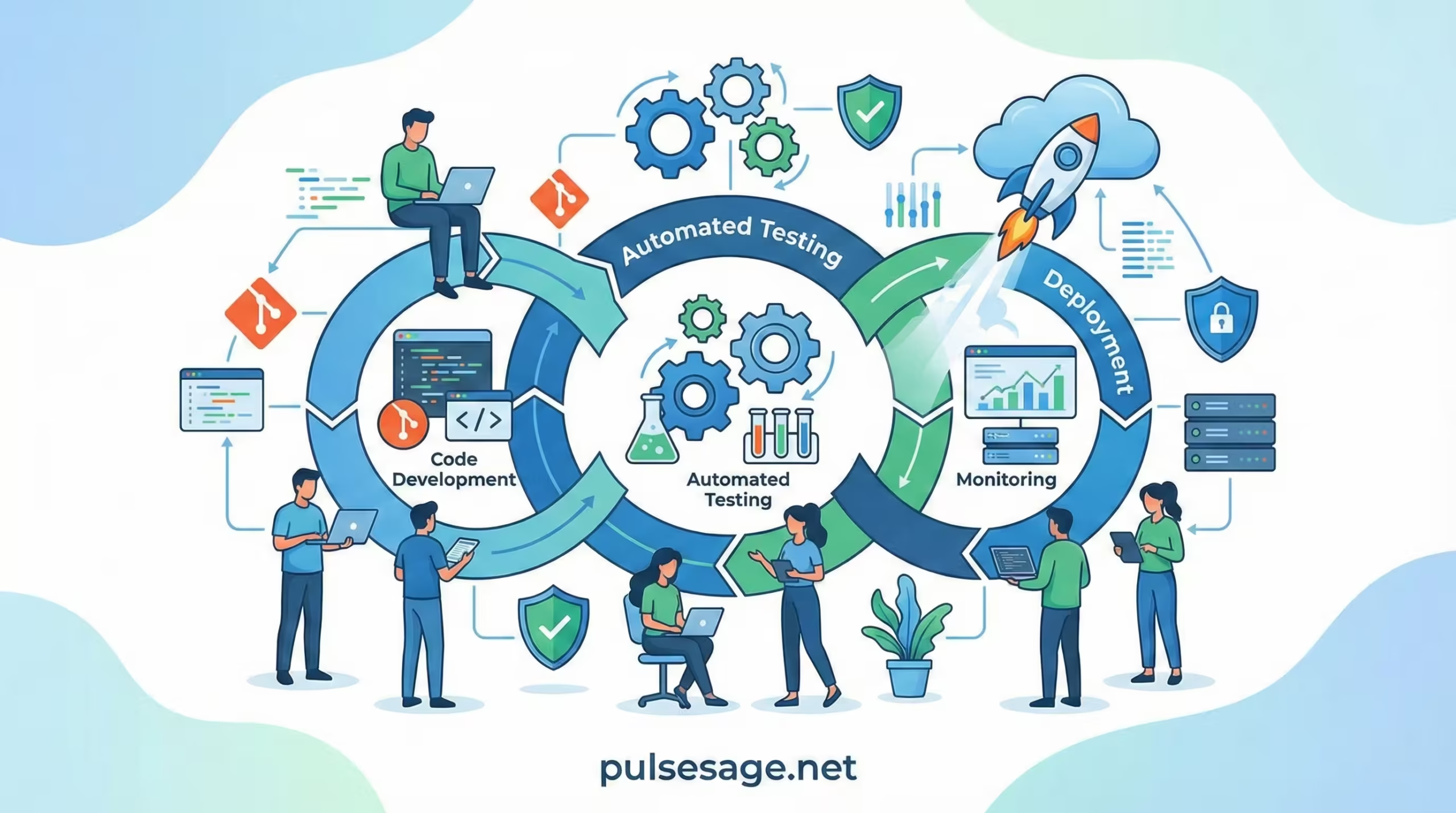
Introduction: The DevOps Debate
What DevOps Actually Means in 2025
DevOps is a software development methodology that combines cultural philosophies, practices, and tools to increase an organization’s ability to deliver applications and services at high velocity. The term itself merges “Development” and “Operations,” signaling the breaking down of traditional silos between teams that build software and teams that deploy and maintain it. This integration creates a process framework ensuring collaboration throughout the entire software lifecycle.
At its core, DevOps establishes practices that enable development and operations teams to collaborate, automate processes, and continuously improve how software reaches production environments. This methodology emphasizes shared responsibility, where developers understand operational concerns and operations teams engage with development processes. The result is faster, more reliable software delivery that responds effectively to business needs and customer feedback.
Modern DevOps in 2025 has expanded beyond its original scope to encompass security through DevSecOps, incorporate platform engineering principles, and leverage cloud-native technologies. However, the fundamental goal remains unchanged: delivering high-quality software quickly and reliably while fostering a culture of continuous improvement. DevOps provides the framework for organizations to innovate faster, respond to market changes more effectively, and maintain competitive advantages in rapidly evolving digital landscapes.
The methodology encompasses several key practices including continuous integration, continuous delivery, infrastructure as code, monitoring and logging, and communication and collaboration. These practices work together to automate manual tasks, standardize environments, and create feedback loops that drive constant improvement. Understanding DevOps as a holistic approach rather than merely a toolset or job title clarifies why it remains fundamentally relevant regardless of technological shifts.
Core Benefits Proving DevOps Value
The enduring relevance of DevOps stems from concrete benefits that directly impact business outcomes. Organizations adopting DevOps practices consistently report improvements across multiple dimensions, from development speed to product quality and team satisfaction.
Faster Time-to-Market
Speed represents one of the most recognized benefits of DevOps. Through continuous integration and continuous delivery pipelines, organizations automate code builds, testing, and deployment processes. This automation enables teams to release new features and updates much faster than traditional waterfall or siloed approaches. Companies practicing DevOps can deploy hundreds of updates daily while maintaining stability, allowing them to seize market opportunities before competitors and respond rapidly to customer feedback.
The acceleration comes not from rushing through processes but from eliminating bottlenecks, reducing handoff friction, and automating repetitive tasks. Development teams no longer wait days or weeks for operations to provision environments or deploy code. Instead, automated pipelines handle these tasks in minutes or hours, dramatically compressing release cycles without sacrificing quality or introducing additional risk.
Improved Collaboration and Communication
DevOps fundamentally transforms how teams work together by breaking down organizational silos that traditionally separated development from operations. When these teams collaborate under shared goals and responsibilities, communication improves dramatically, bottlenecks disappear, and issues resolve faster. This enhanced collaboration extends beyond development and operations to include security, quality assurance, and business stakeholders.
The cultural shift toward shared responsibility means developers consider operational concerns like scalability, monitoring, and incident response during development. Operations teams engage earlier in the development process, providing input on architecture decisions and deployment strategies. This end-to-end collaboration creates mutual understanding and respect between teams, fostering a more productive and satisfying work environment.
Higher Software Quality and Reliability
Automation stands at the core of DevOps quality improvements. Automated testing, code quality checks, and deployment validation reduce human errors that commonly plague manual processes. The shift-left testing approach, where quality assurance begins early in development rather than occurring solely before release, catches bugs when they’re easiest and cheapest to fix. This results in more stable, reliable software that performs better in production.
Continuous monitoring and feedback loops enable teams to detect and address issues quickly. Rather than discovering problems after major releases, DevOps practices surface concerns immediately through automated monitoring, alerting, and observability tools. This proactive approach to quality management prevents small issues from becoming major incidents, maintaining system stability and user satisfaction.
Significant Cost Savings
DevOps reduces costs through multiple mechanisms. Automation eliminates repetitive manual tasks, allowing teams to focus on high-value activities that drive innovation. Infrastructure as code ensures consistency while cutting down operational overhead associated with manual infrastructure management. The reduction in deployment failures, faster issue resolution, and decreased downtime all contribute to substantial cost savings.
Organizations also save by consolidating tools onto unified DevOps platforms rather than maintaining disparate systems requiring custom integrations. These platforms provide better visibility, reduce tool sprawl, and lower licensing and maintenance costs. Additionally, catching bugs early in development costs significantly less than fixing production issues, providing another avenue for cost reduction.
Enhanced Scalability and Flexibility
DevOps practices enable organizations to scale infrastructure and applications efficiently, particularly in cloud environments. Infrastructure as code allows teams to provision resources programmatically, scaling up or down based on demand without manual intervention. This flexibility proves essential for businesses experiencing growth, seasonal fluctuations, or unpredictable traffic patterns.
The methodology also provides flexibility in team structure and resource allocation. DevOps as a Service allows businesses to outsource DevOps processes to experts, avoiding the costs and challenges of building in-house teams. This approach offers scalability perfect for startups and growing enterprises that need to adapt quickly to changing demands without long-term commitments to specific team sizes or skill sets.
Essential DevOps Practices in Modern Development
Understanding the specific practices that make DevOps effective demonstrates why the methodology remains indispensable. These practices have evolved and matured but continue forming the foundation of efficient software delivery.
Continuous Integration and Continuous Delivery
CI/CD represents the automation backbone of DevOps. Continuous Integration involves automatically building and testing code whenever developers commit changes to version control. This practice catches integration issues immediately rather than allowing them to accumulate. Continuous Delivery extends this by automatically deploying tested code to staging or production environments, ensuring software remains in a releasable state.
Modern CI/CD pipelines incorporate automated security scanning, compliance checks, and comprehensive testing suites. These pipelines serve as guardrails ensuring only quality, secure code reaches production. The automation reduces manual effort, eliminates human error in deployment processes, and provides consistent, repeatable releases that teams can trust.
Infrastructure as Code
Managing infrastructure through code rather than manual configuration represents a transformative DevOps practice. Infrastructure as Code treats servers, networks, and cloud resources as programmable entities defined in version-controlled files. This approach ensures consistency across environments, eliminates configuration drift, and makes infrastructure changes reviewable and reversible.
Tools like Terraform, Ansible, and cloud-native solutions enable teams to define entire infrastructure stacks declaratively. When infrastructure exists as code, provisioning new environments becomes automated and reliable, supporting rapid scaling and disaster recovery scenarios. This practice also reduces costs by making infrastructure changes transparent and auditable.
Monitoring and Observability
DevOps emphasizes continuous feedback through comprehensive monitoring and observability practices. Real-time monitoring tracks application performance, infrastructure health, and user behavior, providing data that helps teams optimize systems and plan improvements. Observability goes deeper, enabling teams to understand system internals and diagnose issues even in complex distributed architectures.
Modern observability platforms combine metrics, logs, and traces to provide complete visibility into system behavior. This visibility proves essential for maintaining reliability, meeting service level objectives, and understanding how changes impact production systems. The feedback loops created by monitoring inform development priorities and operational decisions, ensuring continuous improvement.
Automated Testing
Comprehensive automated testing forms a critical DevOps practice ensuring software quality. Unit tests verify individual components, integration tests check how components work together, and end-to-end tests validate complete user workflows. Automated tests run continuously as part of CI/CD pipelines, providing immediate feedback when code changes introduce problems.
The shift-left testing philosophy moves quality assurance earlier in development, making developers responsible for testing their code before merging changes. This practice catches bugs when they’re easiest to fix and prevents defects from propagating through the development pipeline. Automated testing also enables confident refactoring and rapid experimentation, supporting innovation without compromising stability.
DevSecOps: Security as a Core Practice
The evolution of DevOps to incorporate security demonstrates the methodology’s adaptability and continued relevance. DevSecOps integrates security practices throughout the software development lifecycle rather than treating security as a final gate before release. This integration ensures that innovation doesn’t compromise security and that security concerns don’t unnecessarily slow development.
Modern DevSecOps practices include automated security scanning in CI/CD pipelines, vulnerability assessments integrated with development tools, compliance checking as code, and security testing alongside functional testing. These practices shift security left, addressing vulnerabilities during development when fixes cost less and create fewer delays. Security teams become collaborators rather than gatekeepers, working with development and operations to build secure systems from the ground up.
Tools like Snyk, Aqua Security, and Prisma Cloud enable automated security scanning that integrates seamlessly with existing DevOps workflows. These solutions identify vulnerabilities in code, dependencies, containers, and infrastructure configurations without requiring manual security reviews that create bottlenecks. The automation ensures consistent security practices across all projects while maintaining development velocity.
DevSecOps also emphasizes security culture, where all team members take responsibility for security rather than delegating it to specialized teams. Developers learn secure coding practices, operations teams implement security controls in infrastructure, and security professionals provide guidance and expertise throughout the process. This shared responsibility model proves far more effective than traditional approaches where security reviews occurred only at the end of development cycles.
Real-World Success Stories
Examining how leading organizations leverage DevOps demonstrates its practical value and continuing relevance. These success stories span industries and company sizes, showing that DevOps principles apply universally.
Spotify’s DevOps Excellence
Spotify exemplifies DevOps success, deploying hundreds of updates daily while maintaining a smooth experience for millions of users worldwide. The company organizes teams into autonomous squads that own complete features end-to-end, from development through operations. This structure embodies DevOps principles of shared responsibility and rapid iteration.
Spotify’s approach emphasizes continuous deployment, comprehensive monitoring, and a culture of experimentation. Teams deploy changes frequently, measure results, and iterate based on data. This methodology enables Spotify to innovate rapidly, respond to user feedback quickly, and maintain its position as a leading streaming platform. The company’s success directly demonstrates how DevOps practices drive innovation, user satisfaction, and market leadership.
Amazon’s Continuous Deployment
Amazon pioneered many DevOps practices, deploying code to production every 11.7 seconds on average. This remarkable deployment frequency stems from comprehensive automation, microservices architecture, and strong DevOps culture. Amazon’s success shows that DevOps scales to massive organizations handling millions of transactions daily.
The company’s commitment to automation extends beyond deployment to include infrastructure management, testing, and monitoring. Amazon’s practices influenced the broader industry, with AWS services reflecting lessons learned from internal DevOps implementation. This real-world validation at scale demonstrates DevOps principles work even in the most demanding environments.
Netflix’s Reliability Engineering
Netflix built its streaming platform on DevOps principles, achieving exceptional reliability despite serving billions of hours of content globally. The company’s chaos engineering practices, where engineers intentionally introduce failures to test system resilience, represent advanced DevOps thinking. Netflix’s culture emphasizes autonomy, automation, and learning from failures.
The organization’s success in maintaining service quality while deploying continuously shows DevOps enables both speed and reliability. Netflix’s open-source contributions, including tools like Spinnaker for continuous delivery, demonstrate commitment to DevOps practices and help other organizations adopt similar approaches.
Common DevOps Tools and Platforms
The DevOps ecosystem includes numerous tools supporting various practices. Understanding key tools helps organizations build effective DevOps implementations tailored to their needs.
Version Control and Collaboration
GitHub, GitLab, and Bitbucket provide version control, code review, and collaboration features essential for DevOps. These platforms enable teams to work together effectively, tracking changes, reviewing code, and maintaining project history. Modern DevOps relies heavily on Git-based workflows that facilitate continuous integration and collaboration.
CI/CD Platforms
Jenkins, CircleCI, GitHub Actions, and GitLab CI/CD automate build, test, and deployment processes. These platforms form the automation backbone of DevOps, executing pipelines that transform code changes into deployed applications. Choosing the right CI/CD platform depends on team needs, existing infrastructure, and desired features.
Container and Orchestration Tools
Docker revolutionized application packaging, while Kubernetes provides orchestration for containerized applications at scale. These technologies enable consistent deployment across environments, efficient resource utilization, and simplified scaling. Container-based approaches have become fundamental to modern DevOps implementations.
Infrastructure as Code Tools
Terraform, Ansible, Chef, and Puppet enable infrastructure management as code. These tools support declarative infrastructure definitions, version control for infrastructure changes, and automated provisioning. Infrastructure as code has become a cornerstone practice in modern DevOps.
Monitoring and Observability
Prometheus, Grafana, Datadog, and New Relic provide monitoring, alerting, and observability capabilities. These tools give teams visibility into system behavior, performance metrics, and potential issues. Effective monitoring supports continuous improvement and reliable operations.
Why DevOps Remains Essential
Several factors ensure DevOps remains critical for software development organizations regardless of emerging trends or competing methodologies. Understanding these factors clarifies why DevOps represents a lasting approach rather than a temporary fad.
Business Velocity Requirements
Modern businesses compete on speed, requiring rapid feature development, quick bug fixes, and immediate responses to market changes. DevOps provides the only proven methodology for achieving this velocity sustainably. Organizations cannot afford waterfall development cycles or siloed teams when competitors deploy continuously and iterate based on user feedback. The business imperative for speed makes DevOps practices essential rather than optional.
Complexity Management
Software systems continue growing more complex with microservices architectures, distributed systems, and cloud-native technologies. Managing this complexity requires the automation, collaboration, and continuous feedback that DevOps provides. Without DevOps practices, organizations struggle to maintain reliability, security, and performance as systems scale. The methodology offers proven patterns for managing complexity effectively.
Talent Expectations
Modern software professionals expect DevOps practices, automated workflows, and collaborative cultures. Engineers increasingly choose employers based on development practices, tooling, and automation maturity. Organizations without DevOps struggle to attract and retain top talent who want to work with modern tools and practices. DevOps has become a competitive requirement for talent acquisition.
Customer Expectations
Users expect frequent updates, quick bug fixes, and continuously improving software experiences. Companies meeting these expectations gain competitive advantages, while those with slow release cycles lose market share. DevOps enables organizations to meet and exceed customer expectations through continuous delivery and rapid iteration based on feedback.
Economic Efficiency
DevOps practices deliver measurable return on investment through reduced costs, faster time-to-market, and improved quality. Organizations practicing DevOps report significant cost savings from automation, reduced downtime, and fewer production incidents. The economic benefits make DevOps essential for organizations seeking operational efficiency and competitive positioning.
Evolution, Not Obsolescence
Confusion about DevOps relevance often stems from its evolution rather than any fundamental obsolescence. The methodology continuously adapts to new technologies, practices, and organizational needs while maintaining core principles.
Platform engineering represents an evolution of DevOps rather than a replacement. Platform teams build internal developer platforms that abstract infrastructure complexity, but these platforms embody DevOps principles of automation, self-service, and collaboration. Platform engineering extends DevOps by providing standardized, automated paths for common tasks while maintaining the cultural emphasis on shared responsibility and continuous improvement.
Cloud-native architectures leverage DevOps practices extensively. Serverless computing, containerization, and managed services require automation, monitoring, and deployment pipelines that DevOps pioneered. These technologies make DevOps more relevant by increasing deployment frequency and operational complexity that manual approaches cannot handle effectively.
Site Reliability Engineering complements DevOps by applying software engineering practices to operations problems. SRE teams build automated solutions, define service level objectives, and manage reliability through engineering rather than manual intervention. This approach aligns perfectly with DevOps principles and extends them into reliability engineering.
The integration of AI and machine learning into DevOps workflows represents another evolution. AI-powered tools help with anomaly detection, predictive scaling, and automated remediation. These capabilities enhance DevOps practices rather than replacing them, making teams more effective at maintaining reliable, performant systems.
Implementing DevOps Successfully
Organizations seeking to adopt or improve DevOps practices benefit from understanding proven implementation approaches. Successful DevOps transformation requires attention to culture, practices, and tools.
Start with culture and mindset shifts before focusing on tools. DevOps fundamentally represents a cultural change emphasizing collaboration, shared responsibility, and continuous learning. Organizations must break down silos, encourage experimentation, and create psychological safety where teams learn from failures. Leadership support proves critical for cultural transformation, as does celebrating collaboration and shared successes.
Implement practices incrementally rather than attempting complete transformation simultaneously. Begin with continuous integration, ensuring all code changes merge frequently and pass automated tests. Add continuous delivery once CI stabilizes, automating deployments to staging environments. Gradually extend automation to production deployments as confidence and capabilities grow. This incremental approach builds skills and demonstrates value progressively.
Choose tools that fit team capabilities and organizational needs rather than adopting every trendy technology. Start with version control, automated testing, and basic CI/CD pipelines. Add infrastructure as code, monitoring, and advanced practices as teams gain experience. Unified DevOps platforms like GitLab or Azure DevOps provide integrated toolchains that simplify implementation.
Measure progress using meaningful metrics that reflect business outcomes. Track deployment frequency, lead time for changes, mean time to recovery, and change failure rate. These metrics, popularized by the DORA research program, correlate with organizational performance and provide objective measures of DevOps maturity. Regular measurement enables continuous improvement and demonstrates value to stakeholders.
Invest in training and skill development to build DevOps capabilities. Teams need skills in automation, cloud platforms, scripting, and new tools. Provide learning opportunities through courses, workshops, and hands-on projects. Consider DevOps as a Service or consulting partnerships to accelerate learning and avoid common pitfalls during transformation.
Challenges and How to Overcome Them
DevOps implementation faces common challenges that organizations should anticipate and address proactively. Understanding these challenges and solutions increases transformation success.
Cultural resistance represents the primary challenge in DevOps adoption. Teams accustomed to siloed operations may resist shared responsibility and collaborative workflows. Overcome resistance through clear communication about benefits, leadership modeling desired behaviors, celebrating collaborative successes, and providing support during transitions. Cultural change takes time and requires persistent, consistent effort from leadership and early adopters.
Skills gaps can slow DevOps adoption as teams learn new tools, practices, and workflows. Address gaps through structured training programs, mentorship from experienced practitioners, gradual implementation allowing learning time, and partnerships with DevOps consultants. Building internal expertise takes investment but proves essential for sustainable DevOps practices.
Legacy systems and technical debt complicate DevOps implementation. Old applications may lack automated tests, use outdated deployment methods, or have tightly coupled architectures. Address legacy challenges by modernizing incrementally, starting DevOps practices with new projects, creating abstraction layers for old systems, and allocating time for technical debt reduction. Complete legacy transformation isn’t required before beginning DevOps adoption.
Tool complexity and sprawl create challenges when organizations adopt numerous specialized tools without integration. Avoid tool sprawl by starting with essential tools, choosing integrated platforms over point solutions, evaluating tools based on specific needs rather than trends, and standardizing where possible. Unified DevOps platforms reduce complexity significantly compared to custom tool chains.
Security concerns sometimes slow DevOps adoption, with security teams worried about rapid deployments. Address security through DevSecOps practices integrating security early, automated security testing in pipelines, clear security policies codified in tools, and collaboration between security and development teams. Modern DevSecOps approaches improve security while maintaining deployment velocity.
The Future of DevOps
DevOps will continue evolving to address emerging challenges and leverage new technologies. Several trends indicate where DevOps is heading in coming years.
AI and machine learning integration will accelerate, with intelligent systems handling more operational tasks autonomously. AIOps platforms will predict issues before they impact users, automatically scale resources based on predicted demand, and suggest optimizations based on performance data. These capabilities will extend DevOps automation into areas currently requiring human judgment.
Platform engineering will mature as organizations build sophisticated internal developer platforms. These platforms will provide self-service capabilities, standardized workflows, and automated guardrails that make DevOps practices accessible to all developers. Platform teams will focus on developer experience, treating internal teams as customers and continuously improving platform capabilities.
FinOps practices integrating financial accountability into DevOps will become standard. As cloud costs grow, organizations need visibility into spending and automated optimization. DevOps workflows will incorporate cost awareness, with automated policies preventing expensive deployments and dashboards showing resource consumption alongside performance metrics.
Edge computing and IoT will extend DevOps practices to distributed environments. Organizations will need to deploy, monitor, and update applications across thousands or millions of edge locations. DevOps automation and practices will adapt to these distribution challenges, enabling reliable operations at unprecedented scale and geographic diversity.
Sustainability considerations will influence DevOps practices as organizations focus on environmental impact. Green DevOps will emphasize efficient resource utilization, carbon-aware deployment scheduling, and optimization for energy efficiency. Monitoring dashboards will include environmental metrics alongside performance and cost data.
FAQs About DevOps
Is DevOps still relevant in 2025?
Yes, DevOps remains highly relevant in 2025. Organizations practicing DevOps report faster deployments, better collaboration, improved quality, and significant cost savings. While the methodology has evolved to incorporate new practices like DevSecOps and platform engineering, its core principles of automation, collaboration, and continuous improvement continue driving software delivery excellence.
What are the main benefits of DevOps?
DevOps provides faster time-to-market through automated CI/CD, improved collaboration between development and operations teams, higher software quality through automated testing, significant cost savings through automation and efficiency, enhanced security with DevSecOps practices, better scalability through infrastructure as code, and continuous improvement through monitoring and feedback loops.
What tools do I need for DevOps?
Essential DevOps tools include version control systems like Git, CI/CD platforms like Jenkins or GitLab CI/CD, container technologies like Docker and Kubernetes, infrastructure as code tools like Terraform or Ansible, and monitoring solutions like Prometheus and Grafana. Many organizations use unified platforms like GitLab or Azure DevOps that integrate multiple capabilities.
How is DevOps different from traditional development?
Traditional development separates teams into silos with development throwing code over the wall to operations. DevOps breaks down these silos, creating shared responsibility for the entire software lifecycle. DevOps emphasizes automation, continuous delivery, frequent small releases, and collaborative culture, while traditional approaches often involve manual processes, large infrequent releases, and limited cross-team collaboration.
What is DevSecOps?
DevSecOps integrates security practices throughout the software development lifecycle rather than treating security as a final gate. This approach includes automated security scanning in CI/CD pipelines, vulnerability assessments integrated with development tools, compliance checking as code, and security testing alongside functional testing. DevSecOps ensures security without slowing development velocity.
Can small teams benefit from DevOps?
Yes, DevOps benefits organizations of all sizes. Small teams often see faster results from DevOps adoption because they have fewer organizational barriers and can implement changes quickly. Starting with basic automation and gradually adding practices allows small teams to improve continuously without overwhelming resources. Many cloud platforms and DevOps tools offer free tiers suitable for small teams.
How long does DevOps transformation take?
DevOps transformation is an ongoing journey rather than a one-time project. Organizations typically see initial benefits within 3-6 months of implementing basic practices like continuous integration. Full transformation including cultural change, comprehensive automation, and mature practices may take 1-3 years depending on organization size, existing practices, and transformation scope. Incremental implementation delivers value continuously throughout the journey.
What metrics should I track for DevOps success?
Track the four key DORA metrics: deployment frequency measuring how often you deploy to production, lead time for changes measuring time from commit to production, mean time to recovery measuring how quickly you restore service after incidents, and change failure rate measuring percentage of deployments causing failures. These metrics correlate with organizational performance and provide objective measures of DevOps maturity.